
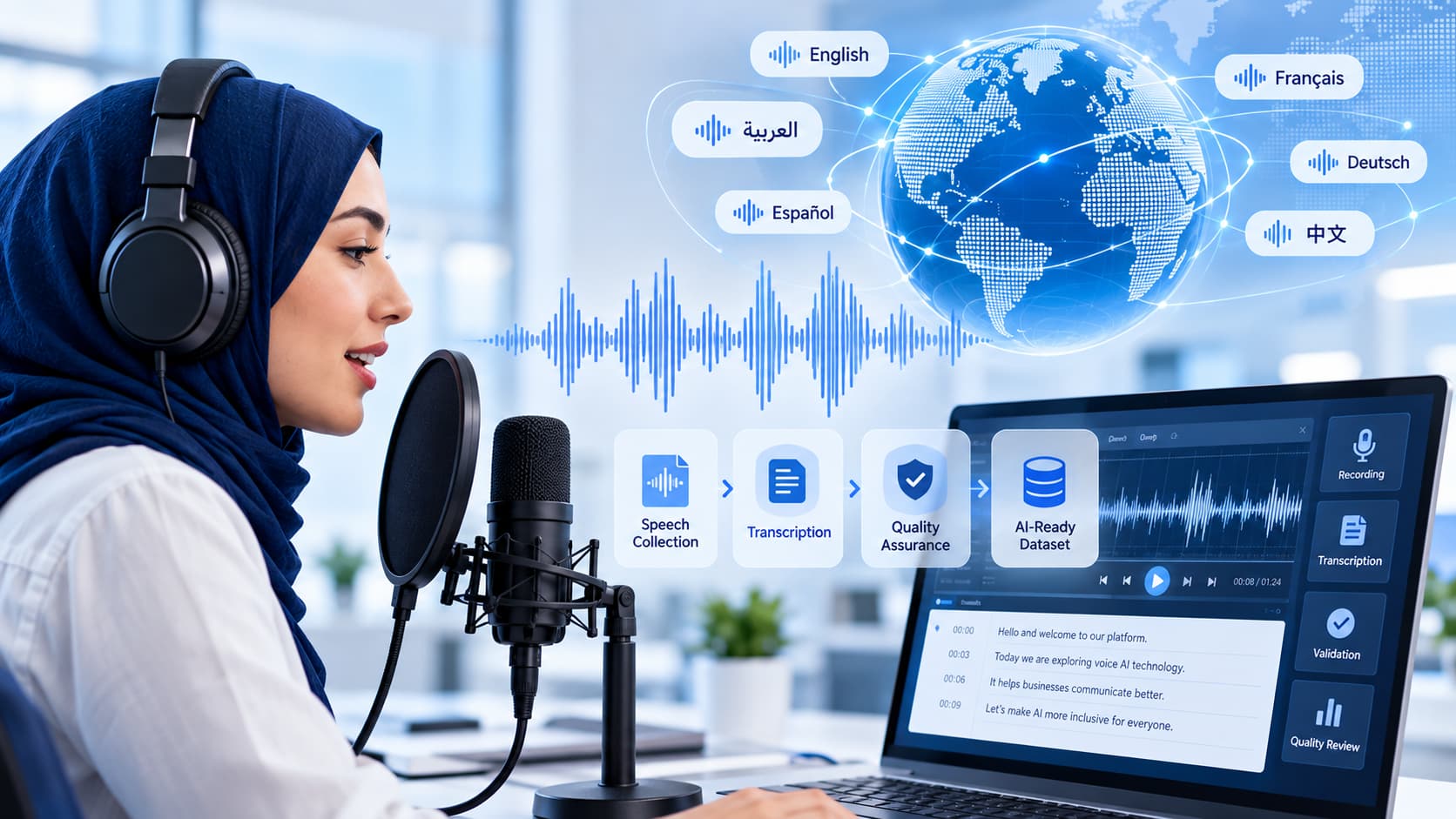
Why Diverse Speech Data Is Essential for Building Better Voice AI
Voice-enabled AI has become part of everyday digital experiences. Virtual assistants, voice search, customer service systems, transcription tools, accessibility applications, smart devices, and conversational platforms all depend on one critical resource: high-quality speech data.
For these systems to understand people accurately, they must learn from the way people actually speak. That includes different languages, accents, dialects, speaking styles, environments, ages, and recording conditions.
A voice model trained on limited or overly uniform data may perform well during testing but struggle when it encounters real users. Building reliable voice AI therefore requires more than simply collecting large volumes of audio. The dataset must reflect the diversity and complexity of real-world speech.
What Is Speech Data?
Speech data refers to recorded human voice content used to train, test, or evaluate AI systems that process spoken language.
Depending on the project, speech datasets may include:
- Read speech
- Conversational speech
- Command-based recordings
- Call-center conversations
- Spontaneous speech
- Short voice prompts
- Long-form audio
- Single-speaker recordings
- Multi-speaker conversations
- Domain-specific terminology
Speech data may also be accompanied by metadata such as language, dialect, speaker information, timestamps, or recording conditions.
These elements help AI development teams organize and use the data effectively.
Why Voice AI Needs Diverse Data
Human speech is highly variable.
Two people speaking the same language may pronounce words differently. Vocabulary can vary by region. People may speak quickly, slowly, formally, casually, clearly, or with background noise.
Voice AI systems need exposure to these differences during training.
If a speech recognition model is trained only on one accent, it may perform poorly when users speak with another accent.
If it is trained only in quiet environments, it may struggle with recordings from streets, offices, vehicles, or public spaces.
Diversity therefore helps models become more resilient when they move from controlled development environments into real-world use.
Language Is Only One Part of Speech Diversity
Multilingual projects often focus first on language coverage, but language alone does not fully describe how people speak.
Within a single language, there may be many regional variations.
Pronunciation, vocabulary, sentence structure, and conversational style can change between countries, cities, communities, and age groups.
For example, a voice system designed for a global audience may need to understand multiple varieties of English rather than treating English as one uniform speech pattern.
The same applies to Arabic, Spanish, French, and many other languages.
For this reason, speech data projects may need to consider not only language but also geographic and cultural context.
The Importance of Natural Speech
Scripted recordings are useful because they allow project teams to control exactly what is being recorded.
However, natural conversational speech introduces additional patterns that scripted datasets may not fully capture.
Real conversations include:
- Hesitations
- Repeated words
- Interruptions
- Informal expressions
- Pauses
- Fillers
- Changes in speaking speed
- Incomplete sentences
These characteristics are part of normal human communication.
For conversational AI systems, training on realistic speech patterns can help improve how models understand real interactions.
Recording Conditions Matter
The environment in which speech is recorded can significantly affect audio quality.
Some datasets may require studio-quality recordings. Other projects may intentionally include realistic background noise.
Depending on the target application, speech may need to be collected through:
- Smartphones
- Headsets
- Laptop microphones
- Professional microphones
- Mobile applications
- Telephone systems
Different devices produce different audio characteristics.
If a voice model is expected to operate across many devices, including varied recording conditions during data collection can help create a more representative dataset.
Speech Collection Requires Clear Project Design
Successful speech data collection begins with defining the project requirements.
Teams need to determine what type of speech should be recorded, which languages are required, how many speakers are needed, what devices should be used, and what quality standards must be followed.
Recording instructions also need to be clear.
Contributors may need guidance on:
- Speaking pace
- Recording environment
- Pronunciation
- Distance from the microphone
- File format
- Recording duration
- Background noise requirements
- Re-recording criteria
Well-designed instructions reduce inconsistent recordings and improve the overall usability of the dataset.
From Audio Recording to Usable AI Data
Collecting audio is only the first stage.
Recorded speech often needs additional processing before it can be used for AI training.
This may include transcription, segmentation, timestamping, validation, metadata assignment, or quality review.
A typical workflow could look like:
Speech Collection → Audio Review → Transcription → Segmentation → Validation → Quality Assurance → Delivery
Each step improves the structure and reliability of the final dataset.
The Role of Transcription
Transcription connects spoken audio with written language.
This connection is important for many speech technologies, including automatic speech recognition systems.
Accurate transcription helps models learn the relationship between audio patterns and written words.
Depending on the project, transcription guidelines may specify how to handle:
- Pauses
- Background sounds
- Mispronunciations
- Incomplete words
- Speaker changes
- Numbers
- Proper names
- Non-speech sounds
Consistency is critical.
If different transcribers use different rules, the dataset may become harder for AI systems to learn from.
Speaker Diversity Improves Dataset Coverage
A strong speech dataset often benefits from including different speakers.
Variables may include:
- Gender
- Age groups
- Regional accents
- Native and non-native speakers
- Speaking styles
- Voice characteristics
The appropriate balance depends on the goal of the AI system.
The objective is not simply to increase the number of speakers but to make sure the dataset reflects the users the system is expected to serve.
Quality Assurance in Speech Data Projects
Audio datasets can contain errors that are difficult to detect automatically.
A recording may contain excessive noise, missing words, incorrect prompts, clipped audio, or inconsistent volume.
Transcriptions may also contain spelling errors, missing segments, or incorrect timestamps.
Quality assurance helps identify these problems before the dataset is delivered.
A multi-stage review process may include:
Recording Validation
Checking whether the recording meets technical and project requirements.
Transcription Review
Confirming that written text accurately represents the audio.
Metadata Validation
Ensuring that language, speaker, and file information is correctly assigned.
Final Dataset Review
Checking formatting, file structure, and overall consistency.
These review stages help reduce errors that could otherwise affect model training.
Speech Data for Multilingual AI
As AI products expand into global markets, multilingual speech support becomes increasingly important.
A system designed for international users may need to process many languages and dialects.
This introduces operational challenges.
Project teams need contributors who understand the target languages and can follow consistent recording and transcription guidelines.
Localization knowledge can also become important when prompts contain culturally specific expressions or terminology.
A multilingual workflow therefore combines technical requirements with linguistic understanding.
Scaling Speech Data Collection
Small pilot projects may require only a limited number of recordings.
Large AI projects can require significantly more data across multiple languages and speaker profiles.
Scaling introduces challenges such as:
- Recruiting contributors
- Managing recording tasks
- Tracking completion
- Maintaining consistent quality
- Handling multiple languages
- Reviewing large audio volumes
Structured project management becomes essential.
Tasks need to be distributed clearly, contributor performance should be monitored, and quality checks should remain consistent across the project.
Speech Data for Different AI Applications
Different voice technologies require different types of datasets.
Automatic Speech Recognition
ASR systems convert speech into text.
They require audio recordings paired with accurate transcriptions.
Virtual Assistants
Voice assistants need to understand commands, questions, and conversational language.
Datasets may include short commands, long questions, and varied speaking styles.
Conversational AI
Conversational systems benefit from natural dialogue data, including realistic pauses and informal speech.
Voice Search
Search systems need to recognize names, products, locations, and natural search queries.
Accessibility Technology
Speech data can help build tools that support users who rely on voice interfaces.
Each application requires a dataset designed around its specific use case.
Preparing Speech Data for Model Evaluation
Speech data is not used only for training.
It can also be used to evaluate AI models.
A separate evaluation dataset can help teams measure how well a model performs across different speakers, languages, accents, and environments.
This can reveal weaknesses that might not appear in a general accuracy score.
For example, a model may perform well overall but struggle with a specific accent or background-noise condition.
Targeted evaluation data helps development teams understand these differences.
Why Human Review Still Matters
Automated tools can assist with audio processing, but human review remains valuable.
Humans can recognize context, pronunciation, speaker intent, and language variations that automated systems may misinterpret.
Human reviewers can also identify unusual cases that need additional attention.
For multilingual speech projects, native or fluent contributors can help ensure that recordings and transcriptions reflect the correct linguistic context.
Building Speech Datasets for Real-World AI
The most useful speech datasets are designed around real usage conditions.
A voice system that will be used internationally should be trained on diverse languages and speakers.
A system designed for noisy environments should encounter similar conditions during development.
A conversational assistant should learn from natural speech rather than only perfect studio recordings.
Dataset design should therefore start with a simple question:
Who will use the AI system, and how will they speak to it?
The answer should influence the data collection strategy.
How Gigverse Solutions Supports Speech & Voice Projects
Gigverse Solutions supports multilingual speech and voice data projects through data collection, transcription, validation, and quality assurance workflows.
Projects can be structured according to language, speaker profile, recording conditions, data format, and technical requirements.
A global contributor network can support projects across multiple languages and markets, while structured review workflows help maintain consistency throughout the data lifecycle.
The objective is to help AI teams receive organized and usable speech datasets suitable for training, testing, and model evaluation.
Better Voice AI Starts With Better Speech Data
Voice technology is ultimately designed to understand people.
That means the data used to develop it should reflect the variety of ways people actually speak.
Language diversity, speaker diversity, recording environments, transcription accuracy, and quality control all contribute to the reliability of a speech dataset.
When these elements are considered from the beginning, AI development teams can build voice systems that are better prepared for real-world users.
High-quality speech data does more than increase dataset size.
It helps AI listen better, understand more accurately, and work across a wider range of people, languages, and environments.